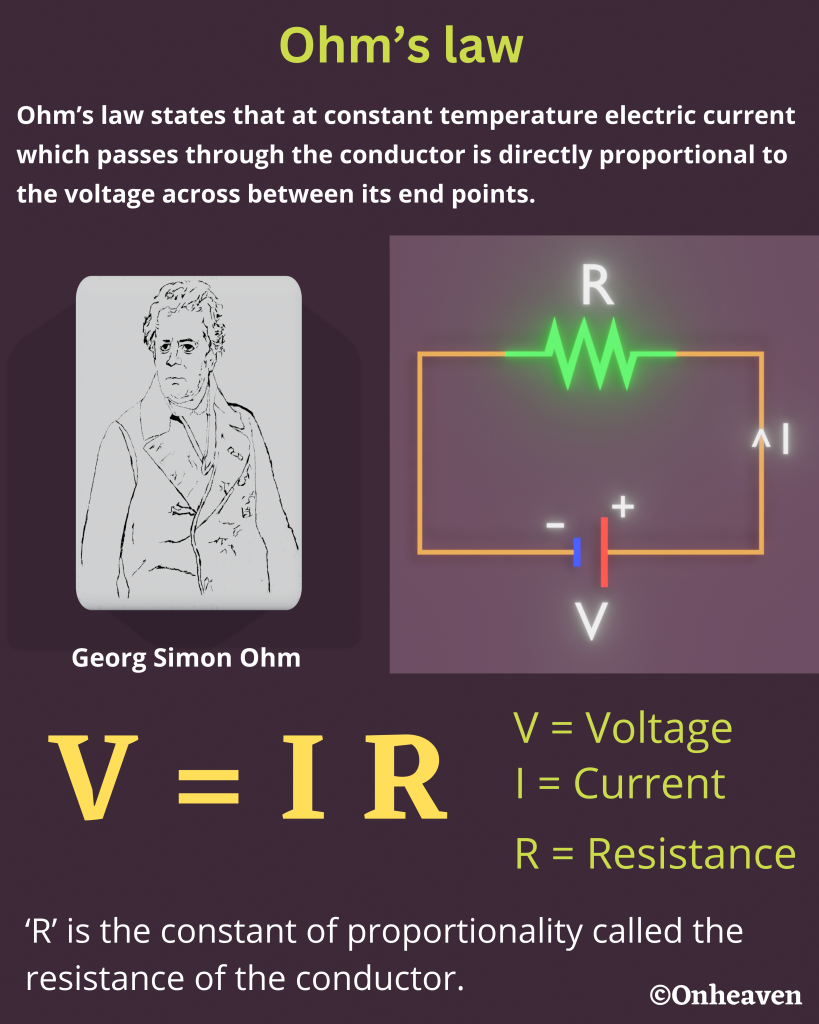
Ohm’s law states that at constant temperature electric current which passes through the conductor is directly proportional to the voltage across between its end points.
If ‘I’ is the current flowing through the wire and ‘V’ is the voltage applied across it, at a constant temperature.
Then the relationship is given as ‘I’ is directly proportional to ‘V’.
V = Voltage between conductor’s end points.
I = Current flowing through the conductor.
Here circuit, its circuit diagram.
At constant temperature,
‘I’ is directly proportional to ‘V’.
V equal to I R
At constant temperature,
I ∝ V (At constant temperature.)
V = I R
‘R’ is the constant of proportionality called the resistance of the conductor.
R is equal to V by I.
Or it is also written as I is equal to V by R.
R = V/I
or
I = V/R
The SI unit of Resistance is ohm.