Faraday’s law of induction was proposed by Michael Faraday in the year 1831.
This law states that, how the change in the magnetic field linked with the conductor induces the electromotive force in the conductor.
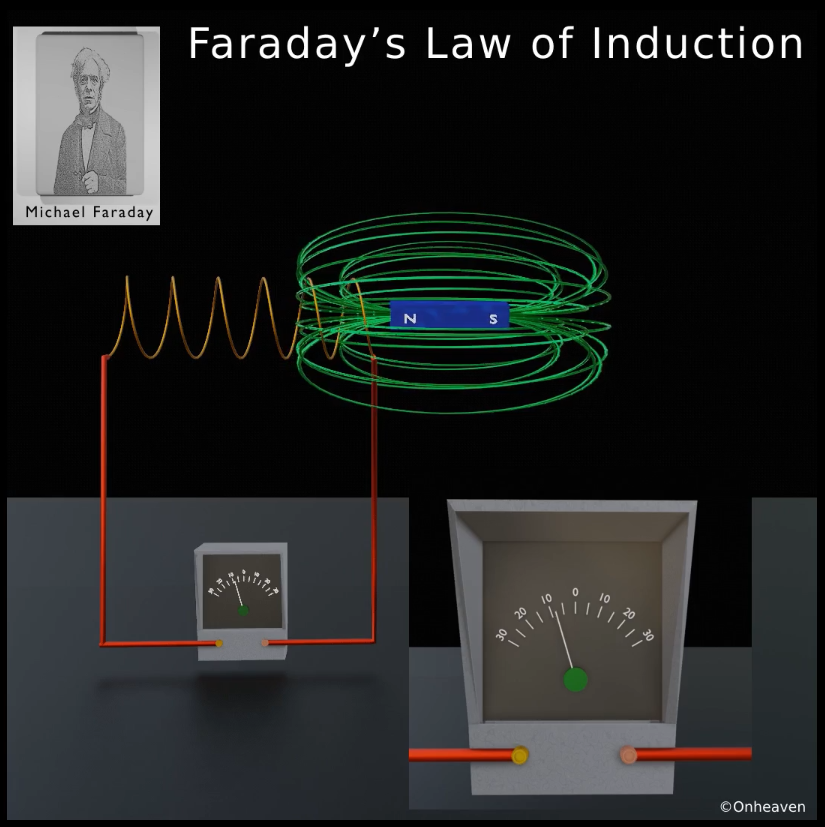
The conductor coil is connected to the galvanometer.
A bar magnet is going near the conductor coil.
As the magnetic field of the bar magnet starts interacting with the coil. The galvanometer starts showing deflection.
As the higher amount of magnetic field of the bar magnet is linked with the coil, the galvanometer which is connected to the conductor coil shows more and more deflection.
When the bar magnet stops movement the galvanometer switches back to no deflection which shows no current in the conductor coil.
Again after moving the magnet in the backward direction the galvanometer starts showing deflection.
As the bar magnet moves back from the galvanometer the magnetic field linked with the conductor coil starts decreasing, then the deflection magnitude in the galvanometer is also starts decreasing.
When the bar magnet moves far away from the conductor coil so that no magnetic field of the bar magnet is linked with the coil. The deflection needle in the galvanometer switches back to the no deflection, which shows no current in the coil.