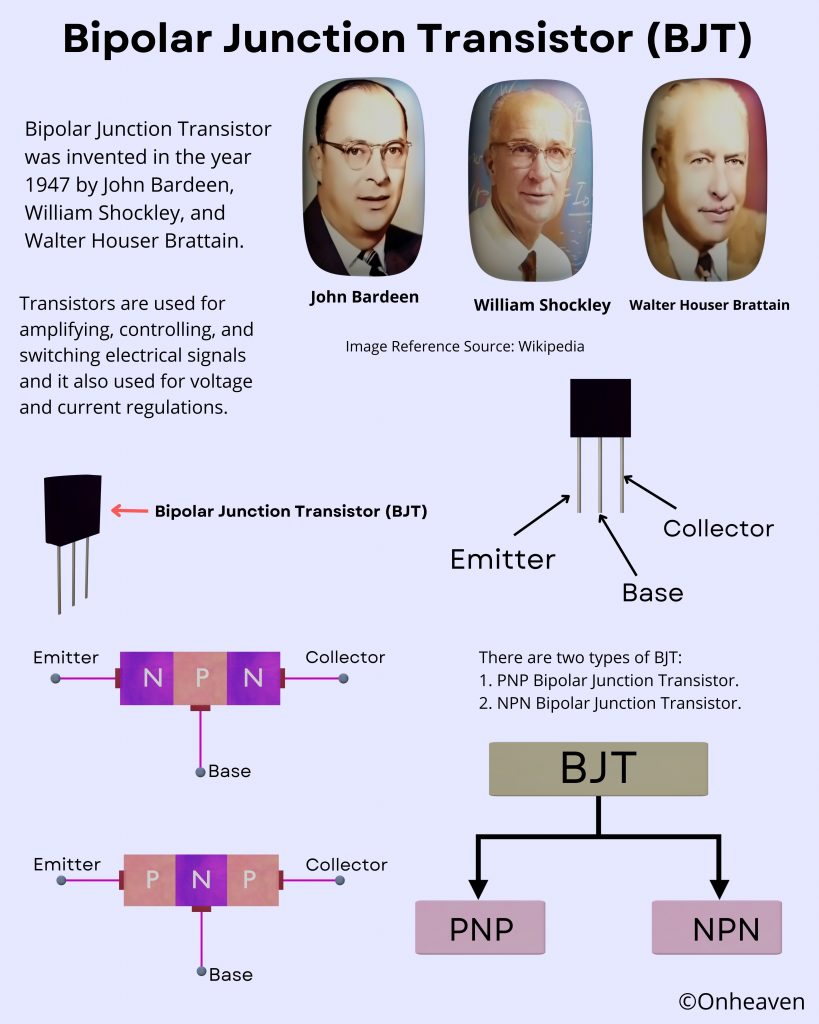
BJT stands for Bipolar Junction Transistor.
Bipolar Junction Transistor was invented in the year 1947 by John Bardeen, William Shockley, and Walter Houser Brattain.
There are two types of BJT:
1. PNP Bipolar Junction Transistor.
2. NPN Bipolar Junction Transistor.
Transistors are used for amplifying, controlling, and switching of electrical signals and it also use for voltage and current regulations.
It consists of three doped region which is emitter, base and collector.
Emitter is heavily doped semiconductor, base is lightly doped semiconductor and collector is moderately doped semiconductor.
In N-type BJT, the emitter is n-type semiconductor, base is p-type semiconductor, and collector is n-type semiconductor.
In P-type BJT, the emitter is p-type semiconductor, base is n-type semiconductor, and collector is p-type semiconductor.
BJT have three operating region based on base-emitter junction and base-collector junction:
- Active Region: In active region base-emitter junction is forward biased and base-collector junction is reversed biased.
- Saturation Region: In saturation region both base-emitter junction and base-collector junction is forward biased.
- Cut-off Region: In cut-off region both base-emitter junction and base-collector junction is reversed biased.
BJT is set in the circuit by designing on of the region is common in both input ans output signal.
There are three configuration of BJT:
- Common Emitter (CE): Emitter is common terminal in both input side and output side of the circuit.
- Common Base (CB): Base is common terminal in both input side and output side of the circuit.
- Common Collector (CC): Collector is common terminal in both input side and output side of the circuit.